Saturday, July 19, 2008

Batak Wedding Ceremonies

Batak Traditions

Batak is a tribe that originally lives in Northern part of Sumatra Island, Indonesia. There exist six kinds of Batak in Indonesia: Toba, Simalungun, Mandailing, Karo, Pakpak, and Nias. They live in different areas, thus, own moderately different traditions. Principally, Batak traditions are operated to organize the relationships of Batak people. So, the traditions are sort of regulations within Batak.

Dalihan Na Tolu is the principle tradition of Batak. It is a triangle bond between brothers, sisters, and brothers of the mother. In a Batak wedding ceremony dalihan na tolu of the groom and dalihan na tolu of the bride will be involved. Terre is a Batak Toba. The Batak wedding traditions, as follow, are based on Batak Toba traditions.


Toba Lake, North Sumatera


Pre-wedding

This phase starts with searching for a Batak woman. Batak grooms have to search among the other 451 marga, clan, for a wife since the tradition stipulates that a man may not marry a woman from his own clan. In Batak traditions, it is taboo for a woman coming initially to a man. Both being in love and decided to get married, the next step is marhusip, which is having the groom’s representative visiting the bride’s family. However, since a Batak can only marry another Batak, Steve has to be adopted by a willing Batak clan and thereby marry a Batak wife according to tradition. Steve will be adopted by Gultom family and receive Gultom as his Batak marga.

At marhusip, the groom and his Batak family (core family) will visit the bride’s family to discuss ensue between the two families to determine if everyone is in agreement with the marriage, what the dowry will be, where the wedding will be held, how many people will be invited, what the wedding will cost, and who will pay for it. Men and women are separated during these discussions, with the men making all the decisions.

Once an agreement has been achieved, the next ceremony is called marhata sinamot. Somehow this ceremony is similar to the marhusip discussion but dalihan na tolu of the groom and the bride are involved.

The main step of pre wedding is martumpol, the engagement. This ceremony takes place in a church. The groom and the bride vow their desires to get marry and promise to build a Christian family in front of the church elders and dalihan na tolu of both. After martumpol each family get together at their own place to prepare their parts for the wedding ceremony. The ceremony is called martonggo raja by the groom’s side and marria raja by the bride’s side. In a Batak wedding, families are the wedding organizers. The families will discuss about details, such as who will be raja parhata (master of ceremony), the representative at giving the gifts, the representative at receiving the gifts, the timetable, etc.


Tor Tor, Batak Toba Traditional Dance


The Wedding

The wedding day is started with marsibuhai-buhai, having breakfast together at the bride’s. The groom will take the bride to the church for a holy matrimony. Afterwards the bride, the groom, and the families will have a Batak wedding ceremony. Typical affirmation of Batak wedding is as follow:

The wedding is attended by dalihan na tolu and neighbours of the groom and the bride.

The groom’s family gives the bride’s family Namargoar ni juhut, A head, some ribs, a tail part of a cow, a buffalo, or a pig that are arranged and cooked in Batak style. The bride’s family then gives the groom’s family dengke, some goldfish that are cooked in Batak style. These gifts are exchanged before lunch.

Somba ni adat and somba ni uhum, offerings usually money, will be given by the groom’s family to the bride’s.

At least five ulos, traditional Batak cloth like a sarong, ulos na marhadohoan (meaning ulos that is produced for a special occasion) will be given by the bride’s family to the groom’s. The newlyweds will receive at least two ulos holong (meaning ulos that is given based on love) from the parents and the families.


Ulos

Post Wedding

Paulak Une is a visiting ceremony when the groom and his core family come to hula-hula, the bride’s family, to show their honours and respects to the bride and her family in protecting the bride’s virginity. Through this tradition, Batak parents educate their children to not having sex before marriage, which also follows the teaching of Bible. If the bride is no longer a virgin, the visiting ceremony will still be completed but called paulak boru.

Maningkir Tangga is a consequent visiting of the bride’s family to the newlywed’s house. This is sort of an informal one, like a casual visiting. Its purpose is to strengthening the relationship between the groom and the parents in law, showing love of the parents to their daughter and to observing how well the groom and his family taking care their daughter.

ULOS RAGI HOTANG

Detai


Ulos Ragi Hotang is the Batak name given to this ceremonial mantle or shawl which is worn at a ceremony announcing the birth of a boy or at a wedding. At the wedding, the groom�s father drapes the cloth over the shoulders of the bride and groom and wishes them happiness and a large family. Woven on a backstrap loom in the Lake Toba region of Northern Sumatra, the central area has a stippled motif which represents rattan bark dyed into the cotton warp threads and gold threads woven into the inner border. The outer border (see enlargement) of floating (supplementary weft) decoration was added during the weaving. This photograph does not do justice to the beauty of this collector's piece. The dimensions are 67 inches long by 39 inches wide.

A Brief History of Nommensen


1_264685568l_1 Dr. Ludwig Ingwer Nommensen was born in Nordstrand Island on , Schleswig-Holstein State, between Denmark and Germany on February 6, 1834. Supported by Rcheinische Mission Gesellschaft (RMG), in1861Nommensen sailed for Sumatra. In 1864 he was able to settle among the Toba Bataks in the valley of Silindung, Northern Sumatra. It was the beginning of a singular Christian career of outstanding self-denial and unfailing dedication. He preached the Gospel in word and deed among the Batak people of a territory still independent of Dutch colonial administration. Though in the beginning their behavior seemed strange to him in many ways, he respected their human dignity and recognized their inalienable right to their own convictions. He mastered t heir language and built bridges of trust.

Nommensen owed his outlook and convictions not only to his seminary training but also to the Lutheran revival movement in Schleswig-Holstein. Throughout his life he interpreted Christianity as "New Life," as taught by F. A. G. Tholuck (1799-1872) and A. Neander (1789-1850). Tholuck and Neander's theological and philosophical positions pervaded the teaching Nommensen received during his seminary years. In Sumatra he and his fellow missionaries explicated the New Life in every aspect of indigenous experience: daily life and order, custom, law, time, age, and rule. These key words represented the kerygmatic paradigm for their evangelistic outreach. Nommensen committed himself to see that New Life penetrated Batak life and culture.

The anthropocentric orientation of his theology led him to evangelize dialogically. He introduced instructions for baptism by posing questions about bliss, eternal life, and obedience to the triune God, rather than by starting with the creation story in Genesis and the people of Israel. His idea of an organically growing Christian life and ethos rested on unshakable trust in Christ. He led his dialogue partners to grasp the meaning of salvation, emphasizing the second coming of Christ. He communicated his theology and method to his fellow missionaries, instructing them for their communication with the Batak people: "Bear them on a priestly heart and preach the Word to them in season and out of season. Everyone who comes to you, you should look upon as being sent by the Lord, and devote as much time to him as is needed to show him the way of life." Nommensen emphasized that one must master the Batak language in order to "live and demonstrate one's life to the heathen and study their way of thinking."

Nommensen integrated the revival tradition of his early years in Germany into his daily theology. Central to his belief was the sovereignty of God, who has revealed himself in his living Word, Jesus Christ, "Lord and Savior of the world." By faith in the living Lord, Christians share in Christ's victory over sin, death, and Satan. Nommensen emphasized the Satan figure in the baptismal instructions and employed it in his teaching and preaching, thereby showing sensitivity to the supernatural sphere of life. His faith in the power of the incarnation (Phil. 2:5-11) led him to his view of human beings, who are enabled with the love of Christ to serve their fellow men and women. He taught the missionaries, "After one has come to understand the people and to be understood by them, one has to begin with the preaching of the Gospel in having a twofold work, namely to pull down the bulwark of Satan and to build up the house of truth." His conception of the church reflected his anthropological emphasis and res ulted in planting a truly "people's church" among the Batak. By example he demonstrated human solidarity in Christ. He realized this way of life by commissioning local elders and chiefs to "gossip the Gospel" in the village. This ministry of the laity reflected Nommensen's emphasis on the congregation as the gathered people of God under the Word of God. He practiced a contextual ecclesiology by using the customary law and structural elements of the people for the formation of a "people's church," as can be seen in the church constitutions of 1866 and 1881. The strong growth and coherence of the church, especially after the resistance of the traditionalists faded, tended to be accompanied by an uncritical allegiance to the customary law; sometimes it became almost the pivot of Christian living. Nevertheless, the indigenization of Batak Christianity has been regarded as "the secret of the growth and the prosperity of the Christian religion in the Batak land."

Nominensen made a decisive effort to gather the church along "three-self" principles. This approach was meant to help the church survive in case of persecution or the expulsion of European personnel. At the same time, Nommensen, in his paternalism and conservative social ethics, welcomed the colonial administration as the best way for development and progress. In 1904 he even proposed to the Dutch administration how to take possession of hitherto independent Batak territory, and how to divide the districts in the best interest of tribal boundaries.

Because of the growing success of the Batak Mission, Nommensen gained recognition and distinction in Europe. In 1893 he was made knight of the Royal Dutch Order of Orange Nassau; in 1904 the theological faculty of the University of Bonn conferred on him the honorary degree of doctor of theology. October 1911 saw two meaningful fiftieth anniversaries: the beginning of the Batak Mission (October 7, 1861) and Nommensen's ordination to the ministry (October 13, 1861). Moreover, in 1911 he was honored by the queen of Holland who conferred on him the Officer's Cross of the Order of Orange Nassau.

Nomensen1

But Nommensen's legacy lies preeminently in Sumatra and in the Christian church among the Batak. By 1918, the year of his death, the Batak church was firmly established, with 34 pastors, 788 teacher-preachers, and 180,000 members. In addition, sixty European men and women of the Rhenish Mission served as coworkers with the Batak leadership. By virtue of their established Christian community, the Batak were ready to enter a new age. Nommensen translated Luther's Small Catechism, the New Testament in 1878, and several other works into Batak language and wrote hymns and a church order for the Batak church. By 1894 the entire Bible had been translated. Education was stressed, and many elementary schools were established in the villages. Batak mission society extended the mission's works among the people. Nommensen's impact therefore is not so much evident in a collection of writings, or with missionaries who followed his missionary methods; rather it is reflected in an indigenous Christian community that knows what it owes to his love and vision. In the early part of the twentieth century, the Batak church was the largest Protestant church in Southeast Asia. Several Batak Churches (HKBP) have also been built in USA, Europe, Australia, and several countries in Asia.


Salibkasihtarutungsumatxh0_1 In 1954, long after the German mission society had left the island, Nommensen was remembered in the name of a new university, Nommensen University. And on the 150th anniversary of his birth, Nommensen was celebrated in a symposium about the meaning and ongoing relevance of his work for the churches in western Indonesia. This important event was sponsored in 1984 by the theological seminary of the Batak Church (HKBP).

Nommensen died on May 23, 1916. He was buried beside the graves of his wife, daughter, and other missionaries in Sigumpar Village, Toba Samosir Regency. He'd been living there since 1891 till the end of his life. Later on June 29, 1996, Pasombar Foundation restored his cemetry and bulild The Nommensen Memorial. The memorial monument is called Salib Kasih (Love's Cross) and used as an open church.

Although Nommensen has passed away, but his works live forever. He has showed what the true meaning of Love is through his faith and dedication to the Lord manifested in his works among the Batak people.


Nommensens_footprint_memorial_stone

"To live or to die,
alow me to stay among this people for the expansion of your Gospel and your Kingdom. Amen!"


O Tano Batak


Tanobatak


I've been always listening to the song entitled O Tano Batak these few days. It's been a while since the last time I visited Tanah Batak where I ever spent a part of my childhood. Listening to this song makes me longing about homeland. Spending time doing my works while listening to the song is not a bad choice at all. Instead, all memories I had before I move to Java comes in rhyme with the powerful voice of uncle Victor Hutabarat. Felt like flying to the Land of the Kings, Tano Batak. I still remember the situation there. Magnificient hills surrounding beautiful Toba Lake, large paddy fields, water buffalow with the kids joyully sitting on its back, songs sung by sunday schoold children, pine trees, the cool weather, how any halak hita (Bataknese) could forget that.

Anyway, O Tano Batak is widely regarded as one of the unofficial “national anthems” of the Batak people of North Sumatra, Indonesia. This folk song tells the story of someone who has traveled all over the world but still remembers his homeland. Batak choirs often sing it at cultural festivals. Grandpa (RIP) told me this song when I was a kid and he said that everytime the people in Tapanuli, North Sumatra officially welcomed guests, they would sing this song.

O TANO BATAK

Pencipta ; S. Dis Sitompul

O tano Batak haholonganku
Sai namasihol do au tu ho
Ndang olo modom
Ndang nok matangku sai namalungun do au
Sai naeng tu ho

Kor
O tano Batak sai naeng hutatap
Dapothononku tano hogodanganki
O tano Batak andingan sahat
Au on naeng mian di ho sambulon hi.

Molo dung binsar mataniari
Napanapuhon hauma disi
Denggan do ngolu
Si Ganup ari di namaringan di ho
Sambulon hi


O TANAH BATAK

(Terjemahan Indonesia: oleh Barita M. S)
Pencipta ; S. Dis Sitompul

O tanah Batak yang kucinta
Selalu aku rindu padamu
Tak bisa tidur, mataku tak dapat terlelap
Selalu aku ingin datang padamu.

Kor
O tanah Batak selalu ingin kupandang
Aku datangi tanah kelahiranku
O tanah batak kapan sampainya
Aku berada di kau ( disana), kerinduanku

Bila matahari sudah terbit
Yang membuat subur ladang – ladang
Sungguh baik kehidupan sehari – hari
Waktu aku ada di kau (disana)


O BATAK LAND

(English translation: Bruce Gale)
Composer ; S. Dis Sitompul

O Batak land, the land that I love
I always feel I am missing you
You know I can’t sleep, I can’t close my eyes
I just always desire to come to you

Chorus
O Batak land, I want to see you
I want come to the land of my birth
O Batak land, when I arrive there
I will be there always, I miss you

Whenever the sun rises in the sky
It makes the fields just flourish and thrive
So wonderful was life in those days
That is just how it was when I was there

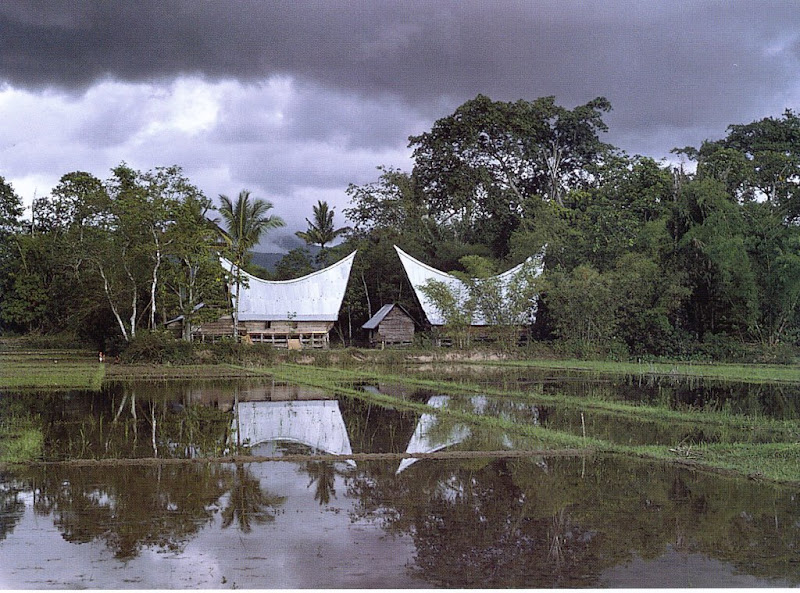
The Batak House in Sumatra


A Batak village, from Dwellings, Paul Oliver, 2003

The Bataks of North Sumatra were said to have practised ritual cannibalism. Marco Polo wrote in 13th century that inhabitants of that island ate their parents when they became too old for work; Raffles in the 19th century stated that for certain crimes a criminal would be eaten alive. According to a New York Times article, the eating of human flesh was always a highly formalized ritual, and the diners were picky - only outsiders, consenting old people and certain kinds of criminals were consumed.

Now the Bataks are mainly Christian: they were converted over a century ago.

“However, Batak Christianity can sometimes seem little more than nominal. You may, for instance, see the pastor beating on a drum for two days to ward off devils, or a church wedding followed by the traditional unjung ceremony, which unites clans by a ritual slaughtering of a water buffalo and a protracted communal bartering over a bride-price. The family and kin group remain the basic Batak social institutions and many aspects of their complex, pre- Christian forms of ancestor worship are still practiced”.


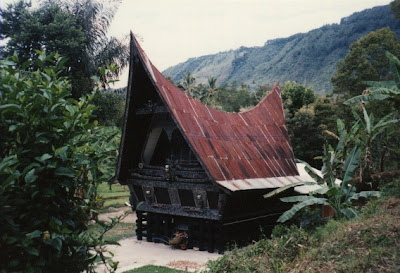
A Batak house, from www.travbuddy.com


The traditional, or adat-style, Batak houses can be large: up to 60 feet long and housing up to 12 families . They have distinctive saddle-backed, twin-peaked roof – like the horns of a buffalo - made from a special palm fibre and commonly anchored by long poles. But now they tend to be made from corrugated steel.


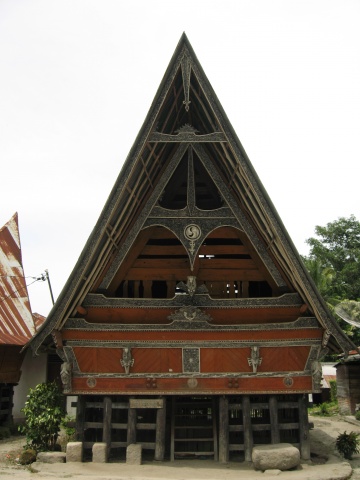
The front of the house, but where is the door? From www.travbuddy.com

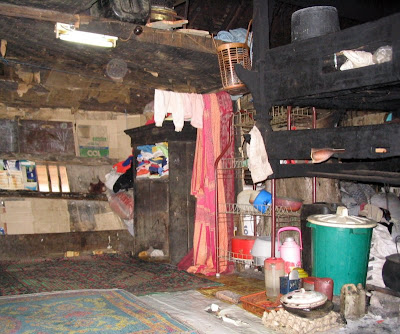
Traditionally, Batak houses have no doors, but are entered by a ladder through a trapdoor in the raised floor. Inside it is dark because there are no windows!


Interior, from www.pbase.com

In some villages the houses are often built in two rows, the rumah or house facing south opposite the sopo facing north. In between is the halaman or plaza from where the grand houses can be admired.

MUSIC BATAK


A typical of Gondang Batak instruments. The musicians, locally called pargonsi, seen here, are wearing the traditional Parmalim costum. Parmalim is the original Batak religion.

Gondang Batak Performs in The Maison des Cultures du Monde festival, 1995


By: Arthur Simon


The larger, official gondang music accompanies ceremonial dances called tortor adat during adat festivities such as the ancestor ceremony, ulaon 'panongkokhon saring-saring', or mangongkal holi, the reburial of remains of ancestors, as well as commemorations for the dead.


However, another type of gondang music, such as gondang riang-riang, or "happy gondang", is used for entertainment or general pleasure during harvest festivals, as accompaniment for dances for young people (gondang naposo), to celebrate the anniversary of the building of a church, or on other public occasions.

Another category of gondang, the gondang arsak, or "sad gondang", may be played at mourning ceremonies for a young man who has died without heirs, or for persons in a melancholic or sentimental mood.

In the past, gondang mandudu were used to call up the spirits of ancestors during dances of spirit possession. Certain other compositions were rituals in the veneration of the ancient Batak gods, such as "gondang Mulajadi na Bolon", "Bane Bulan" (band 3) or "Debata Sori" (band 7). Concerning this latter piece, it should be noted that due to the influence of Christianity, Debata" today means the God of the Christians.

From an architectural point of view, a traditional Toba house reproduces the ancient Batak religious system, according to which the universe is divided into three worlds: the under, middle and upper worlds. During an adat celebration, the gondang musicians occupy the upper level of the house, thus the upper world, and they play the music towards the dancers representing the middle world. The gondang is thus the mediator between the upper and middle worlds, granted by God and sanctified with divine force, and this explains the social prestige of the pargonsi (gondang musicians).

The order of the pieces and dances in gondang is subjected to a specific internal cyclical order. When the adat is strictly observed, each cycle must be composed of seven pieces, the first "gondang mula-mula" and the last of which "gondang hasahatan" are compulsory. If the suite is being performed as entertainment, this order need not be followed.

Festival music is always played by the official gondang. This instrumental group, called gondang sarune, gondang bolon (large gondang) or gondang sabangunan (complete gondang), is made up of the taganing, composed of a set of five tuned drums (tataganing) beaten by a first drummer, a large bass drum called gordang played by a second drummer, a sarune (oboe), four ogung (gongs) and a hesek-hesek (metal plate). A second sarune may be added to the first to strengthen the sound. In addition, in pieces intended for divine worship, certain groups replace the taganing with a small double-headed barrel-drum called odap.

The sarune or sarune bolon (large sarune) is a conical oboe with five upper finger-holes and one lower finger-hole for the thumb. The instrument consists of five interlocking parts: a double reed, a mouth-piece, a disk upon which the musician places his lips (pirouette), a body section and a bell.

From the players' point of view, the taganing drums (measuring 16 to 20 inches) are placed in increasing order from left to right ; all hang on a wooden stand.

The head is of water buffalo, cow or goat skin, and connected to a round wooden plate held in place underneath the drum by means of six tension strings. The desired tuning of each head is achieved by driving in wooden wedges between the base of the drum and this plate. The bass drum gordang is of similar construction, only much bigger, as it measures more that 40 inches in length. These drums are struck by using two drumsticks.

The set of gongs ogung consists of four bossed gongs of varying size and pitch, each of which is struck by one individual player. The oloan ("who must be obeyed"), the lowest gong, and the ihutan ("to follow") or pangalusi ("the answerer") are not muted. The doal na godang ("doal of the parents") and the panggora ("the caller"), of higher pitch, are muted with the arm.

The hesek-hesek, a plate of iron or other metal, or even an empty beer bottle, is beaten regularly as a timekeeper.

In the majority of the pieces, there is an audible opposition between the melodic combination provided by the sarune / taganing group, and the background gong accompaniment, whose psychoacoustic effects may be heard for several miles, and which remains the same throughout the piece.

The sarune's range of notes is roughly: G-, C1, D1, E1, F1, G1, A flat/ A-, played half a note lower. The intonation of individual notes may fluctuate considerably, especially the highest note, which is pressed and used in some particular moments as an intensificatory process. The melodic and thematic units of the gondang repertoire are dependent on the technical possibilities of the sarune playing. The six degrees of the basic range are obtained by playing the five upper finger-holes, and most of the thematic figures use this scale.

Almost all the pieces begin with a kind of standard introduction. The taganing player begins with a characteristic figure, followed by steady beats, from which the other players can take up the tempo, after which the gong section can begin to play.

The main theme as such does not begin until after this introduction. Two main types of themes may be distinguished. First, those with quite distinctive and expressive melodies, subject to a strict symmetric internal structure maintained throughout the entire piece (type 1). Next, themes which employ a technique of increasing tension by the successive transposition of a phrase on the central tones D1 - E1 - F1 - G1 (type 2). The internal structure is almost always asymmetric in this case, and the length of themes can vary due to the amount of freedom allowed in lengthening, determined by the emotional context.

The group consists of:

Marsius Sitohang (left), 40 years old, from Samosir / Medan: sulim (transverse flute) Photo: Repro Tonggo Simangunsong

Kalabius Simbolon, 51 years old, from Samosir / Pematang Siantar: first sarune etek(clarinet)
Osner Gultom, 40 years old, from Porsea: second sarune etek
Sarikawan Sitohang, 35 years old, from Medan, hasapi garantung (first lute)
Janter Sagala, 44 years old, from Samosir / Medan: hasapi doal (second lute)
Maningar Sitorus, 33 years old, from Porsea: garantung (xylophone)
Rizaldi Siagian, 43 years old, from Medan: hesek-hesek (iron plate).

The two brothers, Marsius and Sarikawan Sitohang, as well as Janter Sagala, usually play in their own group "Sitohang Bersaudara," in Medan, and Kalabius Simbolon has his own group in Pematang Siantar. These musicians have inherited the tradition begun by Tilhang Gultom, who pioneered the "Batak Opera" (a form of popular theatre set to music).
source: http://viziers.multiply.com/journal/item/10/Gondang_batak


Sitohang Bersaudara (L-R): Marsius Sitohang, Jonter Sagala and Sarikawan Sitohang (Photo Benhard Sitohang)

JAMBAR

Series Is Discussion [By] Bible & Custom

By: Pdt Daniel Taruli Asi Harahap

JAMBAR is a real term typical of Batak. Said jambar to subject to rights or part determined for someone ( a group of people). Culture Batak mentions there are 3(tiga) type jambar. That is: the right to get animal top to slaughter ( jambar juhut), the right to talk ( jambar hata) and the right to get role or duty in public work or community ( jambar ulaon).

Per Head Batak or group of in public Batak ( hula-hula, dongan sabutuha, boru, dongan sahuta etc) hardly involves x'self as parjambar. That is: man who is having leastwise 3(tiga) rights: speaks, rights gets animal top slaughtered in event of community, and rights stands in public work or community party. So the importance of carrying out of the jambar would, so that if (there are) any people Batak which is not gets or feels trifled the problem of its(the jambar hence s(he can be fulminate big.

1. JAMBAR HATA

First of all per head in community Batak ( except children and people retired have been elderly from adat/ shade manjalo soots hariapan) confessed has rights to speak ( jambar hata). Because that is in every even meeting of community Batak per head and every kelompok/ horong must be given opportunity to speak ( mandok hata) in front of public. If because allocation of time jambar hata must be representation through kelompok/ horong ( hula-hula, dongan tubu, boru etc) hence man who referred that also must speak for kelompok/ horong

what represented it. As symbol s(he must call member of its(the group stands up together with his(its. Possible in a flash of outsider tells that event of mandok this hata hardly verbiage and inefficient.

But intrinsically jambar this hata subjects to confession that per head has the right to release its(the opinion ( read: the right to be listened) in front of public. Isn't it true this very modern and democratic things?

2. JAMBAR JUHUT

Hereinafter jambar juhut subjects to belief in rights per head to get part of animal slaughters in party. Farther. jambar this juhut is symbol that per head [is] entitled to get part of source of energy?powers ( resources) life or blessing given God. Because that is not flesh cutting ( or bone) that all important but belief in existence and rights per head. Because that is we see in even meeting of Batak is not merely result of division of the important animal but especially process assorts it. ( event of mambagi jambar). Because process division of jambar also must be done openly ( transparent) and through consultation and agreement from all party(sides which present, and direct di-fait accompli may not by host or figure someone. Jolo sineat hata asa sineat whittles. Each time fleshy cutting or juhut delivered to which [is] entitled to hence protocol ( parhata) must publicize ( manggorahon) in front of public. Hereinafter each time someone receives jambar hence s(he must return to publicizes it is again to each member of his(its that jambar ( rights) they have received.

Jambar this juhut subjects to life style shares ( sharing) a real relevant with modernity life ( democracy) and Christianity. Life resource or blessing of God may not be enjoyed alone but having to distributed fairly in a a real dialogue process transparent.

This is wrong of contribution of community Batak to public and Indonesia state. That result of its(the development and seyogia Indonesia foreign exchange should be able to also imagined as livestock to slaughter which its(the semesti assorted to all public?people fairly and transparent.

3. JAMBAR ULAON

Jambar ulaon subjects to confession of culture Batak that per head must be involveed and involved in public work. In even meeting of community Batak there is no passive audience, because all people is action partner. Per head is participant ( parsidohot) and functionary ( partohonan). From depth of its(the soul people Batak hardly longing involveed and involved in public work or community.

Basically people Batak longs has role and position in its(the community and public ( including its(the church). If s(he didn't had the role and position, hence possibility happened only two: the people this Batak will go going away or “ generates riot”. On the contrary if s(he figured or entangled, as parsidohot and parjambar and partohonan hence s(he will try shoulders and accounts the work as well as possible and by might and main his(its ( including sacrificing matter). Why men Batak so diligent and forbear staying in custom party? Because over there they have role and position!

4. JAMBAR AND CHANCE

But community Kristen-Batak now still must take heed if only there are still bearing pickings jambar with chance understanding ( sibaran, part, turpuk). Christianity clearly refuses conception about chance ( predestinasi), that is assumption that life, performance and achievement of someone have been determined before all far before s(he borns. Death of Jesus in His crucifix wood and evocation returns from between dead mens has abolished this chance. Old has elapsed because new has arrived ( II KOR 5:17). For people believes nothing that impossible because that is there is no also chance ( Luk 1:37, Kej 18:1 ). God have never planned accident but future that is full expectation for us ( Yer 29:30). Because that for us community Kristen-Batak jambar may not be interpreted as chance. That is mean understanding about jambar must be based on Firman Tuhan.

For us community Kristen-Batak jambar has new meaning: that is life symbol shares byword by Jesus. That is as volunteer Jesus has is dead in crucifix wood memecah-mecah His body and pours His blood for life and kindness of all people, hence we also must always assorts life resource or blessing which we receive to humanity.

In everyday life of we will express that source of economics energy?powers, political and social and cultural the in public and state must be assorted and distributed fairly and flattens, hotly solidarity ( kesetiakawanan).

5. ASSOCIATION AND JUSTICE

Culture Jambar is symbol PERSATUAN and KEADILAN at the same time. By giving to per head and group of what becoming its(the rights ( rights speaks, rights gets resource interior, and rights stands) justice realized and association confirmed at the time of the same. Association unfairly is grind. Justice without association is hostility. Because that: Association of Indonesia also must be understood and involved for the agenda of Social justice for all Indonesia public?people.

6. THEOLOGY JAMBAR IN CHURCH

As church which member of his(its is mostly or most all berlatar-belakang Batak, HKBP will do not willing to must realize this parjambaran culture. That basically every member of HKBP must have rights to speak ( jambar hata), rights enjoys blessing ( jambar juhut) and rights stands ( jambar ulaon). How we accomodate this jambar culture this in liturgy, federation, service, organizational and all ekspressi is having religious service and berjemaat our HKBP?